

Table Salt Substance Or Mixture


Bolivian rose salt from Andes

Salt is a mineral composed primarily of sodium chloride (NaCl), a chemical compound belonging to the larger class of salts; table salt in the form of a natural crystalline mineral is known equally rock salt or halite. Common salt is nowadays in vast quantities in seawater. The open up ocean has about 35 g (ane.2 oz) of solids per liter of sea water, a salinity of 3.5%.
Table salt is essential for life in general, and saltiness is one of the basic homo tastes. Salt is 1 of the oldest and most ubiquitous nutrient seasonings, and is known to uniformly improve the gustatory modality perception of nutrient, including otherwise unpalatable nutrient.[1] Salting, brining, and pickling are likewise ancient and important methods of food preservation.
Some of the primeval evidence of common salt processing dates to effectually half dozen,000 BC, when people living in the area of present-day Romania boiled spring water to extract salts; a salt-works in Communist china dates to approximately the same period. Table salt was too prized by the aboriginal Hebrews, Greeks, Romans, Byzantines, Hittites, Egyptians, and Indians. Salt became an important article of trade and was transported by boat across the Mediterranean Sea, along specially built salt roads, and across the Sahara on camel caravans. The scarcity and universal need for salt have led nations to become to war over information technology and utilise it to raise taxation revenues. Table salt is used in religious ceremonies and has other cultural and traditional significance.
Salt is candy from salt mines, and past the evaporation of seawater (bounding main salt) and mineral-rich jump water in shallow pools. Its major industrial products are caustic soda and chlorine; common salt is used in many industrial processes including the industry of polyvinyl chloride, plastics, paper pulp and many other products. Of the annual global production of effectually two hundred meg tonnes of table salt, about 6% is used for human consumption. Other uses include water conditioning processes, de-icing highways, and agronomical employ. Edible salt is sold in forms such as sea common salt and table salt which usually contains an anti-caking amanuensis and may be iodised to forbid iodine deficiency. Likewise as its utilise in cooking and at the table, salt is present in many processed foods.
Sodium is an essential food for human health via its role equally an electrolyte and osmotic solute.[2] [3] [4] Excessive salt consumption may increment the risk of cardiovascular diseases, such as hypertension, in children and adults. Such health effects of table salt have long been studied. Accordingly, numerous earth health associations and experts in developed countries recommend reducing consumption of popular salty foods.[4] [5] The Globe Health Organization recommends that adults consume less than ii,000 mg of sodium, equivalent to five grams of salt per solar day.[half dozen] [7]
History
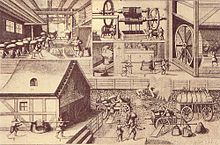
All through history, the availability of salt has been pivotal to civilization. What is now thought to have been the first city in Europe is Solnitsata, in Bulgaria, which was a salt mine, providing the surface area at present known as the Balkans with salt since 5400 BC.[8] Even the name Solnitsata means "salt works".
While people have used canning and artificial refrigeration to preserve food for the last hundred years or and then, salt has been the all-time-known food preservative, especially for meat, for many thousands of years.[9] A very aboriginal salt-works operation has been discovered at the Poiana Slatinei archaeological site adjacent to a salt jump in Lunca, Neamț County, Romania. Evidence indicates that Neolithic people of the Precucuteni Culture were boiling the table salt-laden spring water through the procedure of briquetage to extract the salt every bit far back as 6050 BC.[10] The common salt extracted from this performance may have had a direct correlation to the rapid growth of this society'southward population soon after its initial product began.[11] The harvest of common salt from the surface of Xiechi Lake near Yuncheng in Shanxi, People's republic of china, dates back to at least 6000 BC, making information technology one of the oldest verifiable saltworks.[12]
There is more than salt in animal tissues, such as meat, blood, and milk, than in institute tissues.[13] Nomads who subsist on their flocks and herds do not eat table salt with their food, but agriculturalists, feeding mainly on cereals and vegetable matter, need to supplement their diet with salt.[xiv] With the spread of civilization, common salt became one of the world's main trading commodities. Information technology was of high value to the ancient Hebrews, the Greeks, the Romans, the Byzantines, the Hittites and other peoples of antiquity. In the Middle E, salt was used to ceremonially seal an agreement, and the ancient Hebrews made a "covenant of salt" with God and sprinkled salt on their offerings to evidence their trust in him.[15] [ better source needed ] An ancient practice in time of war was salting the earth: scattering table salt effectually in a defeated city to forbid plant growth. The Bible tells the story of King Abimelech who was ordered by God to practice this at Shechem,[xvi] and various texts claim that the Roman general Scipio Aemilianus Africanus ploughed over and sowed the urban center of Carthage with salt after it was defeated in the Third Punic War (146 BC).[17]
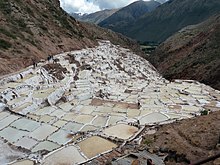
Salt may accept been used for barter in connection with the obsidian trade in Anatolia in the Neolithic Era.[18] Common salt was included among funeral offerings found in ancient Egyptian tombs from the tertiary millennium BC, as were salted birds, and salt fish.[19] From about 2800 BC, the Egyptians began exporting salt fish to the Phoenicians in return for Lebanon cedar, glass, and the dye Tyrian royal; the Phoenicians traded Egyptian salted fish and salt from North Africa throughout their Mediterranean merchandise empire.[20] Herodotus described salt trading routes across Libya back in the fifth century BC. In the early on years of the Roman Empire, roads were built for the transportation of table salt from the salt imported at Ostia to the capital letter.[21]
In Africa, salt was used as currency south of the Sahara, and slabs of rock salt were used as coins in Abyssinia.[14] The Tuareg accept traditionally maintained routes across the Sahara especially for the transportation of salt by Azalai (salt caravans). The caravans nonetheless cross the desert from southern Niger to Bilma, although much of the merchandise at present takes place by truck. Each camel takes two bales of provender and ii of trade appurtenances northwards and returns laden with salt pillars and dates.[22] In Gabon, earlier the arrival of Europeans, the coast people carried on a remunerative trade with those of the interior by the medium of ocean table salt. This was gradually displaced by the salt that Europeans brought in sacks, and then that the coast natives lost their previous profits; every bit of the late 1950s, body of water salt was still the currency best appreciated in the interior.[23]
Salzburg, Hallstatt, and Hallein lie within 17 km (11 mi) of each other on the river Salzach in primal Austria in an surface area with all-encompassing common salt deposits. Salzach literally means "salt river" and Salzburg "salt castle", both taking their names from the German word Salz pregnant common salt. Hallstatt was the site of the world'southward first salt mine.[24] The town gave its proper name to the Hallstatt culture that began mining for table salt in the surface area in near 800 BC. Effectually 400 BC, the townsfolk, who had previously used pickaxes and shovels, began open pan table salt making. During the start millennium BC, Celtic communities grew rich trading salt and salted meat to Ancient Greece and Ancient Rome in exchange for vino and other luxuries.[9]
The word salary comes from the Latin give-and-take for common salt. The reason for this is unknown; a persistent modern merits that the Roman Legions were sometimes paid in salt is baseless.[25] [26] [27] The word salad literally means "salted", and comes from the ancient Roman practice of salting foliage vegetables.[28]
Wars have been fought over salt. Venice fought and won a state of war with Genoa over the product, and it played an important part in the American Revolution. Cities on overland merchandise routes grew rich past levying duties,[29] and towns like Liverpool flourished on the export of common salt extracted from the salt mines of Cheshire.[30] Various governments take at different times imposed salt taxes on their peoples. The voyages of Christopher Columbus are said to have been financed from salt production in southern Spain, and the oppressive common salt revenue enhancement in France was one of the causes of the French Revolution. Later existence repealed, this revenue enhancement was reimposed by Napoleon when he became emperor to pay for his foreign wars, and was not finally abolished until 1946.[29] In 1930, Mahatma Gandhi led a crowd of 100,000 protestors on the "Dandi March" or "Salt Satyagraha", during which they made their own table salt from the sea as a demonstration of their opposition to the colonial common salt tax. This act of civil disobedience inspired numerous Indians and transformed the Indian independence movement from an elitist one with little popular back up into a national struggle.[31]
Chemical science
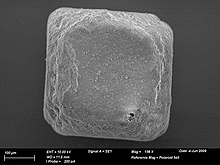
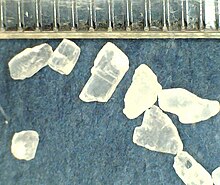
SEM image of a grain of table common salt
Salt is mostly sodium chloride (NaCl). Sea table salt and mined table salt may contain trace elements. Mined common salt is ofttimes refined. Common salt crystals are translucent and cubic in shape; they normally appear white but impurities may give them a blue or purple tinge. When dissolved in water sodium chloride separates into Na+ and Cl− ions, and the solubility is 359 grams per litre.[32] From cold solutions, salt crystallises every bit the dihydrate NaCl·2H2O. Solutions of sodium chloride have very different properties from those of pure water; the freezing bespeak is −21.12 °C (−6.02 °F) for 23.31 wt% of salt, and the boiling point of saturated salt solution is around 108.7 °C (227.7 °F).[33]
Edible table salt
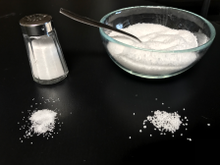
Comparing of table common salt with kitchen table salt. Shows a typical salt shaker and salt bowl with salt spread earlier each on a black groundwork.
Table salt is essential to the wellness of humans and other animals, and it is one of the v basic taste sensations.[34] Salt is used in many cuisines, and it is oftentimes constitute in salt shakers on diners' eating tables for their personal use on food. Salt is also an ingredient in many manufactured foodstuffs. Tabular array salt is a refined table salt containing nearly 97 to 99 percent sodium chloride.[35] [36] [37] Usually, anticaking agents such as sodium aluminosilicate or magnesium carbonate are added to make it free-flowing. Iodized salt, containing potassium iodide, is widely available. Some people put a desiccant, such as a few grains of uncooked rice[38] or a saltine cracker, in their salt shakers to blot extra moisture and help break up salt clumps that may otherwise form.[39]
Fortified table table salt
Some tabular array salt sold for consumption contains additives that address a diverseness of health concerns, especially in the developing world. The identities and amounts of additives vary from land to land. Iodine is an important micronutrient for humans, and a deficiency of the element tin can cause lowered production of thyroxine (hypothyroidism) and enlargement of the thyroid gland (owned goitre) in adults or cretinism in children.[40] Iodized common salt has been used to correct these weather condition since 1924[41] and consists of tabular array table salt mixed with a minute amount of potassium iodide, sodium iodide, or sodium iodate. A small amount of dextrose may also be added to stabilize the iodine.[42] Iodine deficiency affects near two billion people around the world and is the leading preventable cause of mental retardation.[43] Iodized table salt has significantly reduced disorders of iodine deficiency in countries where information technology is used.[44]
The corporeality of iodine and the specific iodine compound added to salt varies. In the United States, the Food and Drug Assistants (FDA) recommends 150 micrograms of iodine per day for both men and women.[45] US iodized salt contains 46–77 ppm (parts per meg), whereas in the UK the recommended iodine content of iodized salt is x–22 ppm.[46]
Sodium ferrocyanide, too known as yellow prussiate of soda, is sometimes added to common salt as an anticaking amanuensis.[47] [48] Such anticaking agents accept been added since at least 1911 when magnesium carbonate was first added to salt to go far flow more than freely.[49] The prophylactic of sodium ferrocyanide every bit a food additive was found to be provisionally acceptable by the Commission on Toxicity in 1988.[47] Other anticaking agents sometimes used include tricalcium phosphate, calcium or magnesium carbonates, fat acid salts (acid salts), magnesium oxide, silicon dioxide, calcium silicate, sodium aluminosilicate and calcium aluminosilicate. Both the European Spousal relationship and the Us Food and Drug Administration permitted the use of aluminium in the latter two compounds.[l]
In "doubly fortified salt", both iodide and iron salts are added. The latter alleviates atomic number 26 deficiency anaemia, which interferes with the mental development of an estimated 40% of infants in the developing world. A typical fe source is ferrous fumarate.[51] Another condiment, especially important for pregnant women, is folic acid (vitamin B9), which gives the table salt a yellow color. Folic acid helps forestall neural tube defects and anaemia, which bear on young mothers, particularly in developing countries.[51]
A lack of fluoride in the diet is the cause of a profoundly increased incidence of dental caries.[52] Fluoride salts can be added to table salt with the goal of reducing tooth decay, peculiarly in countries that accept not benefited from fluoridated toothpastes and fluoridated water. The practice is more common in some European countries where h2o fluoridation is non carried out. In France, 35% of the table table salt sold contains added sodium fluoride.[51]
Other kinds
Unrefined sea salt contains small amounts of magnesium and calcium halides and sulfates, traces of algal products, table salt-resistant bacteria and sediment particles. The calcium and magnesium salts confer a faintly bitter overtone, and they make unrefined sea salt hygroscopic (i.e., it gradually absorbs moisture from air if stored uncovered). Algal products contribute a mildly "fishy" or "sea-air" odour, the latter from organobromine compounds. Sediments, the proportion of which varies with the source, give the salt a boring grey advent. Since taste and odor compounds are often detectable by humans in minute concentrations, sea salt may accept a more complex flavor than pure sodium chloride when sprinkled on top of food. When table salt is added during cooking yet, these flavors would likely be overwhelmed by those of the nutrient ingredients.[53] The refined table salt industry cites scientific studies saying that raw bounding main and stone salts practise not contain enough iodine salts to prevent iodine deficiency diseases.[54]


Salts have various mineralities depending on their source, giving each one a unique flavor. Fleur de sel, a natural bounding main salt from the surface of evaporating brine in salt pans, has a distinctive flavour varying with its source. In traditional Korean cuisine, so-called "bamboo salt" is prepared by roasting common salt[55] in a bamboo container plugged with mud at both ends. This product absorbs minerals from the bamboo and the mud, and has been claimed to increase the anticlastogenic and antimutagenic properties of doenjang (a fermented bean paste).[56]
Kosher or kitchen salt has a larger grain size than table salt and is used in cooking. It tin exist useful for brining, staff of life or pretzel making and as a scrubbing amanuensis when combined with oil.[57]
Pickling salt is made of ultra-fine grains to speed dissolving to make brine.
Salt in food
Salt is nowadays in most foods, just in naturally occurring foodstuffs such every bit meats, vegetables and fruit, it is present in very small quantities. Information technology is oftentimes added to candy foods (such equally canned foods and especially salted foods, pickled foods, and snack foods or other convenience foods), where information technology functions every bit both a preservative and a flavoring. Dairy salt is used in the preparation of butter and cheese products.[58] As a flavoring, common salt enhances the taste of other foods past suppressing the bitterness of those foods making them more palatable and relatively sweeter.[59]
Before the advent of electrically powered refrigeration, salting was one of the chief methods of food preservation. Thus, herring contains 67 mg sodium per 100 1000, while kipper, its preserved grade, contains 990 mg. Similarly, pork typically contains 63 mg while bacon contains 1,480 mg, and potatoes incorporate vii mg but potato crisps 800 mg per 100 one thousand.[13] Table salt is too used extensively in cooking as a flavoring, and cooking techniques such every bit with salt crusts and brining. The principal sources of table salt in the Western nutrition, apart from straight use of sodium chloride, are bread and cereal products, meat products and milk and dairy products.[13]
In many East Asian cultures, common salt is non traditionally used as a condiment.[threescore] In its place, condiments such every bit soy sauce, fish sauce and oyster sauce tend to have a loftier sodium content and fill a similar role to tabular array salt in western cultures. They are most ofttimes used for cooking rather than as table condiments.[61]
Biology of salt gustatory modality
Human being salt gustatory modality is detected past sodium gustation receptors present in sense of taste bud cells on the natural language.[62] Human sensory taste testing studies have shown that proteolyzed forms of epithelial sodium channel (ENaC) role as the human salt taste receptor.[63]
Sodium consumption and health
Tabular array salt is made upwardly of just under twoscore% sodium by weight, then a 6k serving (1teaspoon) contains about ii,400mg of sodium.[64] Sodium serves a vital purpose in the human body: via its role equally an electrolyte, it helps nerves and muscles to part correctly, and it is one factor involved in the osmotic regulation of h2o content in trunk organs (fluid residuum).[65] Most of the sodium in the Western nutrition comes from salt.[4] The habitual salt intake in many Western countries is about 10 chiliad per day, and it is college than that in many countries in Eastern Europe and Asia.[66] The high level of sodium in many processed foods has a major impact on the total corporeality consumed.[67] In the United states, 75% of the sodium eaten comes from processed and restaurant foods, 11% from cooking and table use and the rest from what is establish naturally in foodstuffs.[68]
Because consuming too much sodium increases risk of cardiovascular diseases,[4] health organizations by and large recommend that people reduce their dietary intake of common salt.[4] [69] [seventy] [71] Loftier sodium intake is associated with a greater gamble of stroke, full cardiovascular disease and kidney affliction.[3] [66] A reduction in sodium intake by 1,000 mg per solar day may reduce cardiovascular affliction by about xxx percent.[2] [4] In adults and children with no acute illness, a decrease in the intake of sodium from the typical high levels reduces blood pressure.[70] [72] A low sodium diet results in a greater improvement in blood pressure in people with hypertension.[73] [74]
The Earth Health Organization recommends that adults should swallow less than two,000 mg of sodium (which is contained in fivegrand of salt) per solar day.[69] Guidelines by the U.s. recommend that people with hypertension, African Americans, and middle-aged and older adults should limit consumption to no more than ane,500 mg of sodium per day and meet the potassium recommendation of iv,700 mg/solar day with a salubrious diet of fruits and vegetables.[4] [75]
While reduction of sodium intake to less than 2,300 mg per 24-hour interval is recommended past developed countries,[4] one review recommended that sodium intake be reduced to at least 1,200 mg (independent in 31000 of salt) per 24-hour interval, every bit a farther reduction in salt intake the greater the fall in systolic blood pressure for all historic period groups and ethnicities.[seventy] Another review indicated that there is inconsistent/insufficient show to conclude that reducing sodium intake to lower than 2,300 mg per mean solar day is either beneficial or harmful.[76]
Show shows a more than complicated human relationship betwixt salt and cardiovascular disease. "Mortality caused by levels of salt the clan betwixt sodium consumption and cardiovascular disease or mortality is U-shaped, with increased run a risk at both high and low sodium intake."[77] The findings showed that increased mortality from excessive table salt intake was primarily associated with individuals with hypertension. The levels of increased mortality among those with restricted salt intake appeared to exist similar regardless of blood pressure. This evidence shows that while those with hypertension should primarily focus on reducing sodium to recommended levels, all groups should seek to maintain a good for you level of sodium intake of between four and 5 grams (equivalent to 10-thirteen g salt) a mean solar day.[77]
One of the 2 most prominent dietary risks for disability in the world are diets loftier in sodium.[78]
Non-dietary uses
Merely well-nigh 6% of the common salt manufactured in the world is used in food. Of the remainder, 12% is used in water workout processes, 8% goes for de-icing highways and 6% is used in agronomics.[33] Sodium chloride is one of the largest volume inorganic raw materials. Its major chemic products are caustic soda and chlorine. These are used in the industry of PVC, paper pulp and many other inorganic and organic compounds. Salt is also used equally a flux in the production of aluminium. For this purpose, a layer of melted salt floats on top of the molten metal and removes iron and other metal contaminants. It is also used in the manufacture of soaps and glycerine, where it is used to saponify fats. As an emulsifier, salt is used in the industry of synthetic rubber, and another apply is in the firing of pottery, when common salt added to the furnace vaporises before condensing onto the surface of the ceramic textile, forming a potent glaze.[79]
When drilling through loose materials such as sand or gravel, salt may be added to the drilling fluid to provide a stable "wall" to prevent the hole collapsing. There are many other processes in which salt is involved. These include its employ as a mordant in fabric dying, to regenerate resins in water softening, for the tanning of hides, the preservation of meat and fish and the canning of meat and vegetables.[79] [80] [81]
Production

Food-course salt accounts for but a small part of salt product in industrialized countries (vii% in Europe),[82] although worldwide, food uses account for 17.v% of total production.[83]
In 2018, total world production of salt was 300 meg tonnes, the peak 6 producers being Cathay (68 million), the United States (42 one thousand thousand), Bharat (29 1000000), Frg (thirteen million), Canada (13 million) and Australia (12 million).[84]
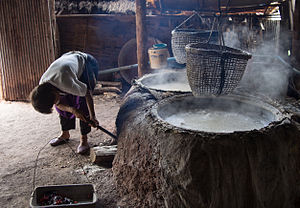
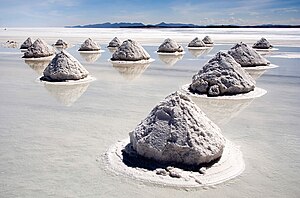
The manufacture of common salt is one of the oldest chemical industries.[85] A major source of salt is seawater, which has a salinity of approximately 3.5%.[33] This means that at that place are about 35 k (ane.two oz) of dissolved salts, predominantly sodium (Na +
) and chloride (Cl −
) ions, per kilogram (2.2 lbs) of water.[86] The world's oceans are a virtually inexhaustible source of table salt, and this affluence of supply means that reserves have not been calculated.[80] The evaporation of seawater is the production method of choice in marine countries with high evaporation and low precipitation rates. Salt evaporation ponds are filled from the body of water and table salt crystals can exist harvested as the water dries upwardly. Sometimes these ponds accept vivid colours, as some species of algae and other micro-organisms thrive in weather condition of high salinity.[87]
Elsewhere, salt is extracted from the vast sedimentary deposits which have been laid downward over the millennia from the evaporation of seas and lakes. These sources are either mined direct, producing stone salt, or are extracted past pumping h2o into the deposit. In either case, the salt may be purified past mechanical evaporation of brine. Traditionally, purification was accomplished in shallow open pans that were heated to accelerate evaporation. Vacuum-based methods are likewise employed.[81] The raw common salt is refined by treatment with chemicals that precipitate most impurities (largely magnesium and calcium salts). Multiple stages of evaporation are so applied.[88] Some table salt is produced using the Alberger process, which involves vacuum pan evaporation combined with the seeding of the solution with cubic crystals, and produces a grainy-blazon scrap.[89] The Ayoreo, an ethnic group from the Paraguayan Chaco, obtain their common salt from the ash produced by burning the timber of the Indian table salt tree (Maytenus vitis-idaea) and other copse.[90]
Ane of the largest salt mining operations in the world is at the Khewra Salt Mine in Pakistan. The mine has xix storeys, eleven of which are underground, and 400 km (250 mi) of passages. The common salt is dug out by the room and pillar method, where about half the material is left in place to support the upper levels. Extraction of Himalayan table salt is expected to final 350 years at the present rate of extraction of around 385,000 tons per annum.[91]
In religion

Salt has long held an important place in religion and culture. At the time of Brahmanic sacrifices, in Hittite rituals and during festivals held by Semites and Greeks at the time of the new moon, salt was thrown into a fire where it produced crackling noises.[92] The ancient Egyptians, Greeks and Romans invoked their gods with offerings of table salt and water and some people think this to be the origin of Holy H2o in the Christian faith.[93] In Aztec mythology, Huixtocihuatl was a fertility goddess who presided over salt and salt water.[94]
Salt is considered to be a very auspicious substance in Hinduism and is used in item religious ceremonies like house-warmings and weddings.[95] In Jainism, devotees lay an offering of raw rice with a pinch of salt earlier a deity to signify their devotion and common salt is sprinkled on a person's cremated remains before the ashes are buried.[96] Table salt is believed to ward off evil spirits in Mahayana Buddhist tradition, and when returning dwelling house from a funeral, a compression of salt is thrown over the left shoulder every bit this prevents evil spirits from entering the business firm.[97] In Shinto, Shio ( 塩, lit. "salt" ) is used for ritual purification of locations and people (harae, specifically shubatsu), and pocket-size piles of salt are placed in dishes by the entrance of establishments for the twofold purposes of warding off evil and attracting patrons.[98]
In the Hebrew Bible, at that place are 30-five verses which mention table salt.[99] One of these mentions Lot's wife, who was turned into a pillar of salt when she looked back at the cities of Sodom and Gomorrah (Genesis 19:26) as they were destroyed. When the gauge Abimelech destroyed the city of Shechem, he is said to have "sown table salt on it," probably as a curse on anyone who would re-inhabit information technology (Judges nine:45). The Book of Job contains the first mention of salt as a additive. "Tin can that which is unsavoury be eaten without salt? or is in that location any gustatory modality in the white of an egg?" (Job 6:six).[99] In the New Testament, six verses mention salt. In the Sermon on the Mount, Jesus referred to his followers as the "salt of the earth". The apostle Paul also encouraged Christians to "let your conversation be always total of grace, seasoned with common salt" (Colossians 4:vi).[99] Table salt is mandatory in the rite of the Tridentine Mass.[100] Salt is used in the third item (which includes an Exorcism) of the Celtic Induction (cf. Gallican Rite) that is employed in the induction of a church. Table salt may exist added to the water "where information technology is customary" in the Roman Catholic rite of Holy h2o.[100]
In Judaism, it is recommended to have either a salty breadstuff or to add together salt to the bread if this bread is unsalted when doing Kiddush for Shabbat. It is customary to spread some salt over the bread or to dip the bread in a fiddling table salt when passing the bread around the tabular array subsequently the Kiddush.[101] To preserve the covenant betwixt their people and God, Jews dip the Sabbath bread in table salt.[93]
In Wicca, common salt is symbolic of the element Earth. It is also believed to cleanse an surface area of harmful or negative energies. A dish of common salt and a dish of h2o are almost e'er present on an altar, and salt is used in a wide variety of rituals and ceremonies.[102]
References
- ^ Institute of Medicine (US) Committee on Strategies to Reduce Sodium Intake (2010). "3 — Taste and Flavor Roles of Sodium in Foods: A Unique Challenge to Reducing Sodium Intake". In Jane E. Henney; Christine Fifty. Taylor; Caitlin South. Boon (eds.). Strategies to Reduce Sodium Intake in the United States. Washington, DC: National Academies Printing (The states). ISBN978-0-309-14806-1 . Retrieved 29 October 2022.
- ^ a b Scientific Study of the 2015 Dietary Guidelines Informational Committee (PDF). US Department of Agriculture. 2015. p. seven. Archived (PDF) from the original on xviii April 2016.
- ^ a b Committee on the Consequences of Sodium Reduction in Populations; Nutrient Nutrition, Board; Board on Population Health Public Health Practice; Constitute Of, Medicine; Strom, B. L.; Yaktine, A. L.; Oria, 1000. (2013). Strom, Brian Fifty.; Yaktine, Ann 50.; Oria, Maria (eds.). Sodium intake in populations: assessment of evidence. Establish of Medicine of the National Academies. doi:10.17226/18311. ISBN978-0-309-28295-6. PMID 24851297. Archived from the original on 19 October 2013. Retrieved 17 October 2013.
- ^ a b c d e f g h "Almost Americans should eat less sodium". Salt. Centers for Illness Control and Prevention. Archived from the original on xix October 2013. Retrieved 17 October 2013.
- ^ "EFSA provides advice on adverse effects of sodium". European Nutrient Prophylactic Authority. 22 June 2005. Archived from the original on four August 2017. Retrieved 9 June 2016.
- ^ "WHO issues new guidance on dietary table salt and potassium". WHO. 31 January 2013. Archived from the original on 20 July 2016.
- ^ Delahaye, F. (2012). "Europe PMC". Presse Médicale. 41 (6 Pt one): 644–649. doi:10.1016/j.lpm.2012.02.035. PMID 22465720. Archived from the original on vii June 2021. Retrieved 7 June 2021.
- ^ LA Times
Bulgarians find oldest European boondocks, a common salt product heart Archived seven March 2016 at the Wayback Automobile - ^ a b Barber 1999, p. 136.
- ^ Weller & Dumitroaia 2005. sfn mistake: no target: CITEREFWellerDumitroaia2005 (help)
- ^ Weller, Bandit & Nuninger 2008, pp. 225–30. sfn error: no target: CITEREFWellerBrigandNuninger2008 (help)
- ^ Kurlansky 2002, pp. 18–19.
- ^ a b c Buss, David; Robertson, Jean (1973). Manual of Diet. Her Majesty'south Stationery Role. pp. 37–38. ISBN978-0-eleven-241112-3.
- ^ a b Woods, Frank Osborne. "Common salt (NaCl)". Encyclopædia Britannica online. Archived from the original on 2 May 2015. Retrieved nine October 2013.
- ^ Suitt, Chris. "Covenant of salt". Rediscovering the Old Attestation. Seed of Abraham Ministries. Archived from the original on 5 March 2016. Retrieved 12 October 2013.
- ^ Gevirtz, Stanley (1963). "Jericho and Shechem: A Religio-Literary Aspect of City Destruction". Vetus Testamentum. 13 (ane): 52–62. doi:10.2307/1516752. JSTOR 1516752.
- ^ Ripley, George; Dana, Charles Anderson (1863). The New American Cyclopædia: a Pop Dictionary of Full general Knowledge. Vol. 4. p. 497. Archived from the original on 6 September 2015.
- ^ Golbas, Alper; Basobuyuk, Zeynel (2012). "The role of salt in the germination of the Anatolian culture". Batman University: Journal of Life Sciences. one (one): 45–54. Archived from the original on eleven Dec 2013.
- ^ Kurlansky 2002, p. 38.
- ^ Kurlansky 2002, pp. 44.
- ^ "A brief history of salt". Time Magazine. 15 March 1982. Archived from the original on 9 May 2016. Retrieved 11 Oct 2013.
- ^ Paolinelli, Franco. "Tuareg Salt Caravans of Niger, Africa". Bradshaw Foundation. Archived from the original on 3 August 2016. Retrieved 11 October 2013.
- ^ Schweitzer, Albert (1958). African Notebook. Indiana University Press.
- ^ Lopez, Billie Ann. "Hallstatt's White Gold: Salt". Virtual Vienna Cyberspace. Archived from the original on x February 2007. Retrieved 3 March 2013.
- ^ Bloch, David. "Economics of NaCl: Salt made the world go circular". Mr Block Archive. Archived from the original on 29 January 2007. Retrieved 19 December 2006.
- ^ "The history of common salt product at Droitwich Spa". BBC. 21 January 2010. Archived from the original on 22 February 2014. Retrieved 28 March 2011.
- ^ Gainsford, Peter (11 January 2017). "Salt and salary: were Roman soldiers paid in salt?". Kiwi Hellenist: Mod Myths near the Aboriginal Globe. Archived from the original on 13 January 2017. Retrieved 11 January 2017.
- ^ Kurlansky 2002, pp. 64.
- ^ a b Cowen, Richard (ane May 1999). "The Importance of Salt". Archived from the original on seven May 2016. Retrieved fifteen October 2013.
- ^ Smith, Mike (2003). "Salt". Appurtenances & Not So Goods: Lineside Industries. Archived from the original on 24 November 2011. Retrieved xv October 2013.
- ^ Dalton 1996, p. 72.
- ^ Forest, Frank Osborne; Ralston, Robert H. "Table salt (NaCl)". Encyclopædia Britannica. Archived from the original on 2 May 2015. Retrieved sixteen October 2013.
- ^ a b c Westphal, Gisbert; Kristen, Gerhard; Wegener, Wilhelm; Ambatiello, Peter; Geyer, Helmut; Epron, Bernard; Bonal, Christian; Steinhauser, Georg; Götzfried (2010). "Sodium Chloride". Ullmann'southward Encyclopedia of Industrial Chemical science. Weinheim: Wiley-VCH. doi:10.1002/14356007.a24_317.pub4.
- ^ "The sense of sense of taste". 16 March 2013. Archived from the original on 8 Apr 2016. Retrieved sixteen October 2013.
- ^ "Tesco Table Table salt 750g". Tesco. Archived from the original on eleven May 2009. Retrieved 5 December 2010.
Nutritional analysis provided with Tesco Table Salt states 38.9 percent sodium by weight which equals 97.three percent sodium chloride
- ^ Table Common salt Archived 5 August 2007 at the Wayback Machine. Wasalt.com.au. Retrieved 7 July 2011.
- ^ The international Codex Alimentarius Standard for Food Grade Salt Archived fourteen March 2012 at the Wayback Auto. (PDF). Retrieved vii July 2011.
- ^ "Rice in Salt Shakers". Enquire a Scientist. Archived from the original on 14 March 2011. Retrieved 29 July 2008.
- ^ "Nutrient Freshness". KOMO News. Archived from the original on 20 August 2011. Retrieved 8 July 2011.
- ^ Vaidya, Chakera & Pearce 2011. sfn error: no target: CITEREFVaidyaChakeraPearce2011 (help)
- ^ Markel 1987. sfn fault: no target: CITEREFMarkel1987 (help)
- ^ "Canning and Pickling salt". Penn State University. Archived from the original on 7 Apr 2013. ; "FAQs". Morton Salt. Archived from the original on 27 September 2014.
- ^ McNeil, Donald G. Jr (sixteen Dec 2006). "In Raising the World's I.Q., the Secret'due south in the Salt". The New York Times. Archived from the original on 9 December 2008. Retrieved 4 December 2008.
- ^ "Iodized table salt". Table salt Constitute. 2009. Archived from the original on xiv February 2013. Retrieved v Dec 2010.
- ^ "21 Code of Federal Regulations 101.nine (c)(8)(iv)". www.accessdata.fda.gov. Archived from the original on 4 March 2021. Retrieved 30 January 2021.
- ^ "Give-and-take Newspaper on the setting of maximum and minimum amounts for vitamins and minerals in foodstuffs" (PDF). Directorate-General Health & Consumers. Archived from the original (PDF) on 3 November 2012. Retrieved 5 December 2010.
- ^ a b Discussions of the safety of sodium hexaferrocyanate in tabular array common salt Archived iv March 2016 at the Wayback Auto. Hansard.millbanksystems.com (5 May 1993). Retrieved 7 July 2011.
- ^ European Committee 2001, p. iii. sfn error: no target: CITEREFEuropean_Commission2001 (help)
- ^ "Morton Salt FAQ". Archived from the original on 19 Jan 2012. Retrieved 12 May 2007.
- ^ Burgess, Wilella Daniels; Bricklayer, Apr C. "What Are All Those Chemicals in My Food?". Schoolhouse of Consumer and Family Sciences, Purdue University. Archived from the original on 11 February 2006. Retrieved 27 February 2011.
- ^ a b c Westphal et al. 2010. sfn error: no target: CITEREFWestphalKristenWegenerAmbatiello2010 (help)
- ^ Selwitz, Ismail & Pitts 2007. sfn error: no target: CITEREFSelwitzIsmailPitts2007 (aid)
- ^ McGee 2004, p. 642.
- ^ "References on nutrient salt & health bug". Salt Constitute. 2009. Archived from the original on 19 September 2010. Retrieved v December 2010.
- ^ Livingston 2005, p. 45.
- ^ Shahidi, Shi & Ho 2005, p. 575.
- ^ "Kosher Common salt Guide". SaltWorks. 2010. Archived from the original on 24 December 2010.
- ^ Pieters, A.J.; Flintstone, D.; Garriott, Due east.B.; Wickson, Eastward.J.; Lamson-Scribner, F.; Brackett, G.B.; Atwater, H.Due west.; Alvord, H.Due east.; Withcombe, J.; Howard, L.O. (1899). Experiment Station Work. Bread and the Principles of Bread Making. U.S. Department of Agriculture. pp. 28–30. Archived from the original on xvi June 2016. Retrieved 17 November 2015.
- ^ Breslin, P. A. S.; Beauchamp, G. K. (5 June 1997). "Common salt enhances flavor by suppressing bitterness". Nature. 387 (6633): 563. Bibcode:1997Natur.387..563B. doi:ten.1038/42388. PMID 9177340. S2CID 205030709.
- ^ "The Table salt of Southeast Asia". The Seattle Times. 2001. Archived from the original on 3 March 2016. Retrieved 7 July 2011.
- ^ "Asian diet". Diet.com. Archived from the original on 11 June 2016. Retrieved 7 July 2013.
- ^ Intake, Plant of Medicine (US) Commission on Strategies to Reduce Sodium; Henney, Jane E.; Taylor, Christine L.; Benefaction, Caitlin S. (2010). Gustatory modality and Flavor Roles of Sodium in Foods: A Unique Challenge to Reducing Sodium Intake. National Academies Press (U.s.). Archived from the original on 9 May 2021. Retrieved 4 Apr 2021.
- ^ Shekdar, Kambiz; Langer, Jessica; Venkatachalan, Srinivasan; Schmid, Lori; Anobile, Jonathan; Shah, Purvi; Lancaster, Amy; Babich, Olga; Dedova, Olga; Sawchuk, Dennis (8 March 2021). "Cell applied science method using fluorogenic oligonucleotide signaling probes and menstruum cytometry". Biotechnology Messages. 43 (5): 949–958. doi:10.1007/s10529-021-03101-5. ISSN 1573-6776. PMC7937778. PMID 33683511.
- ^ "National Food Database for Standard Reference, Basic Written report: 02047, Salt, table". Agronomical Research Service, National Nutrient Database for Standard Reference. United States Department of Agronomics. Archived from the original on 26 April 2016. Retrieved 21 July 2018.
- ^ "Dietary sodium". MedLinePlus. Archived from the original on 19 October 2013. Retrieved 17 Oct 2013.
- ^ a b Strazzullo, Pasquale; D'Elia, Lanfranco; Kandala, Ngianga-Bakwin; Cappuccio, Francesco P. (2009). "Table salt intake, stroke, and cardiovascular disease: meta-assay of prospective studies". British Medical Periodical. 339 (b4567): b4567. doi:10.1136/bmj.b4567. PMC2782060. PMID 19934192.
- ^ "Prevention of cardiovascular illness". National Institute for Wellness and Clinical Excellence. 1 June 2010. Archived from the original on xviii May 2015. Retrieved 5 May 2015.
- ^ "Sodium and food sources". Salt. Centers for Affliction Command and Prevention. Archived from the original on 19 Oct 2013. Retrieved 17 October 2013.
- ^ a b "WHO problems new guidance on dietary table salt and potassium". World Wellness Arrangement. 31 January 2013. Archived from the original on xx July 2016. Retrieved 17 October 2013.
- ^ a b c He, F.J.; Li, J.; Macgregor, G.A. (iii April 2013). "Effect of longer term modest salt reduction on claret force per unit area: Cochrane systematic review and meta-assay of randomised trials". BMJ (Clinical Research Ed.). 346: f1325. doi:10.1136/bmj.f1325. PMID 23558162.
- ^ "Sodium and salt". American Heart Association. 2016. Archived from the original on 17 August 2016. Retrieved 8 June 2016.
- ^ Aburto, Nancy J.; Ziolkovska, Anna; Hooper, Lee; et al. (2013). "Effect of lower sodium intake on health: systematic review and meta-analyses". British Medical Journal. 346 (f1326): f1326. doi:ten.1136/bmj.f1326. PMC4816261. PMID 23558163.
- ^ Graudal, Due north iels Albert; Hubeck-Graudal, Thorbjorn; Jurgens, Gesche (nine April 2017). "Furnishings of low sodium diet versus high sodium diet on blood pressure level, renin, aldosterone, catecholamines, cholesterol, and triglyceride". The Cochrane Database of Systematic Reviews. four: CD004022. doi:x.1002/14651858.CD004022.pub4. ISSN 1469-493X. PMC6478144. PMID 28391629.
- ^ Adler, A. J.; Taylor, F.; Martin, N.; Gottlieb, S.; Taylor, R.S.; Ebrahim, Due south. (18 December 2014). "Reduced dietary salt for the prevention of cardiovascular affliction". The Cochrane Database of Systematic Reviews. 12 (12): CD009217. doi:10.1002/14651858.CD009217.pub3. PMC6483405. PMID 25519688.
- ^ Dietary Guidelines for Americans (PDF). U.South. Section of Agriculture & U.Southward. Section of Health and Human Services. 2010. p. 24. Archived (PDF) from the original on 1 September 2016. Retrieved 29 Apr 2015.
African Americans, individuals with hypertension, diabetes, or chronic kidney affliction and individuals ages 51 and older, contain nigh half of the U.South. population ages 2 and older. While nearly everyone benefits from reducing their sodium intake, the blood pressure of these individuals tends to be even more than responsive to the blood pressure-raising effects of sodium than others; therefore, they should reduce their intake to one,500 mg per twenty-four hours.
- ^ Committee on the Consequences of Sodium Reduction in Populations; Food Nutrition, Board; Board on Population Wellness Public Health Practice; Institute Of, Medicine; Strom, B. L.; Yaktine, A. L.; Oria, M. (2013). five Findings and Conclusions | Sodium Intake in Populations: Assessment of Prove. The National Academies Press. doi:10.17226/18311. ISBN978-0-309-28295-6. PMID 24851297. Archived from the original on 16 May 2017.
- ^ a b Mente, Andrew; O'Donnell, Martin; Rangarajan, Sumathy; Dagenais, Gilles; Lear, Scott; McQueen, Matthew; Diaz, Rafael; Avezum, Alvaro; Lopez-Jaramillo, Patricio; Lanas, Fernando; Li, Wei; Lu, Yin; Yi, Sun; Rensheng, Lei; Iqbal, Romaina; Mony, Prem; Yusuf, Rita; Yusoff, Khalid; Szuba, Andrzej; Oguz, Aytekin; Rosengren, Annika; Bahonar, Ahmad; Yusufali, Afzalhussein; Schutte, Aletta Elisabeth; Chifamba, Jephat; Isle of mann, Johannes F Eastward.; Anand, Sonia S.; Teo, Koon; Yusuf, Due south. (2016). "Associations of urinary sodium excretion with cardiovascular events in individuals with and without hypertension: A pooled assay of data from 4 studies". The Lancet. 388 (10043): 465–475. doi:10.1016/S0140-6736(16)30467-6. hdl:10379/16625. PMID 27216139. S2CID 44581906. Archived from the original on nine January 2022. Retrieved iii October 2020.
- ^ Lim, Stephen S.; Vos, Theo; Flaxman, Abraham D.; Danaei, Goodarz; Shibuya, Kenji; Adair-Rohani, Heather; Amann, Markus; Anderson, H. Ross; Andrews, Kathryn G. (15 Dec 2012). "A comparative risk assessment of burden of illness and injury attributable to 67 take chances factors and risk factor clusters in 21 regions, 1990-2010: a systematic analysis for the Global Brunt of Illness Study 2010". Lancet. 380 (9859): 2224–2260. doi:10.1016/S0140-6736(12)61766-8. PMC4156511. PMID 23245609.
- ^ a b "Salt uses". WA Salt Group. Archived from the original on 11 October 2013. Retrieved ten October 2013.
- ^ a b "Sodium chloride". IHS Chemical. 1 December 2008. Archived from the original on 25 March 2013. Retrieved 12 March 2013.
- ^ a b Kostick 2011. sfn error: no target: CITEREFKostick2011 (assist)
- ^ "Salt Uses". European Salt Producers' Association. Archived from the original on 12 February 2015. Retrieved five May 2015.
- ^ "Roskill Information Services". Roskill.com. thirty March 2011. Archived from the original on 18 June 2003. Retrieved seven July 2011.
- ^ Bolen, Wallace P. (February 2019). "Salt" (PDF). US Geological Survey, Mineral Article Summaries (Study). U.s.a. Geological Survey. Archived (PDF) from the original on 31 July 2019.
- ^ "Salt made the world go round". Salt.org.il. ane September 1997. Archived from the original on 5 Apr 2016. Retrieved 7 July 2011.
- ^ Millero et al. 2008. sfn mistake: no target: CITEREFMilleroFeistelWrightMcDougall2008 (assist)
- ^ "Common salt Ponds, Due south San Francisco Bay". NASA Visible Earth. NASA. 11 Baronial 2009. Archived from the original on 15 July 2016. Retrieved 5 May 2015.
- ^ About salt: Production. The Salt Manufacturers Association
- ^ "Alberger process". Industry of salt: Uses of artificial heat. Encyclopædia Britannica online. Archived from the original on 23 February 2011. Retrieved nine October 2013.
- ^ Schmeda-Hirschmann 1994. sfn mistake: no target: CITEREFSchmeda-Hirschmann1994 (help)
- ^ Pennington, Matthew (25 Jan 2005). "Islamic republic of pakistan common salt mined old-fashioned manner mine". The Seattle Times. Archived from the original on 25 July 2012. Retrieved eleven Oct 2013.
- ^ Enquiry article: Common salt. Encyclopedia of Religion. Archived from the original on 4 March 2016. Retrieved 13 October 2013.
- ^ a b "10+i Things you may not know about Salt". Epikouria. Fall/Winter (3). 2006. Archived from the original on 4 July 2008.
- ^ Quipoloa, J. (2007). "The Aztec Festivals: Toxcatl (Dryness)". The Aztec Gateway. Archived from the original on xvi September 2015. Retrieved 18 March 2013.
- ^ Greyness, Steven (7 December 2010). "What Lies Beneath". Time Mag. Archived from the original on 17 August 2013. Retrieved 13 March 2013.
- ^ "The Final Journeying: What to do when your loved i passes abroad". Archived from the original on 6 March 2016. Retrieved 12 March 2013.
- ^ "Religion: Chasing away evil spirits". History of table salt. Cagill. Archived from the original on 14 March 2014. Retrieved 13 October 2013.
- ^ Can y'all laissez passer the salt, please? Archived 27 March 2012 at the Wayback Machine, Robert Camara, 30 March 2009
- ^ a b c "Dictionary and Discussion Search for '"table salt"' in the KJV". Bluish Letter Bible. Sowing Circle. 1996–2013. Archived from the original on 14 April 2013. Retrieved 13 March 2013.
{{cite web}}: CS1 maint: bot: original URL status unknown (link) - ^ a b southward:Catholic Encyclopedia (1913)/Salt
- ^ Naftali Silberberg Why is the Challah dipped in salt before it is eaten? Archived 20 Jan 2012 at the Wayback Machine, Chabad.org
- ^ Cunningham, Scott (1989). Wicca: A Guide for the Solitary Practitioner. Llewellyn Worldwide. pp. 60, 63, 104, 113. ISBN978-0-87542-118-half dozen. Archived from the original on 9 January 2022. Retrieved 3 October 2020.
Books
- Barber, Elizabeth Wayland (1999). The Mummies of Ürümchi. New York: W.W. Norton & Co. ISBN0-393-32019-7. OCLC 48426519.
- Carusi, Cristina (2008). Il sale nel mondo greco, VI a.C.-3 d.C.: luoghi di produzione, circolazione commerciale, regimi di sfruttamento nel contesto del Mediterraneo antico [Salt in the Greek Earth, from the Sixth Century BC to the Third Century Advert: Places of Production, Apportionment, and Commercial Exploitation Schemes in the Aboriginal Mediterranean] (in Spanish). Edipuglia. ISBN9788872285428.
- Dalton, Dennis (1996). "Introduction to Ceremonious Disobedience". Mahatma Gandhi: Selected Political Writings. Hackett Publishing Company. pp. 71–73. ISBN0-87220-330-1. Archived from the original on 10 August 2016. Retrieved 27 June 2015.
- Kurlansky, Mark (2002). Table salt: A Globe History. New York: Walker & Co. ISBN0-8027-1373-iv. OCLC 48573453.
- Livingston, James V. (2005). Agronomics and soil pollution: new inquiry. Nova Publishers. ISBN1-59454-310-0. Archived from the original on six September 2015. Retrieved 27 June 2015.
- McGee, Harold (2004). On Food and Cooking (2d ed.). Scribner. ISBN9781416556374. Archived from the original on 25 Dec 2020. Retrieved 27 June 2015.
- Multhauf, Robert (1996). Neptune'southward Souvenir. The Johns Hopkins University Press. ISBN978-0801854699.
- Shahidi, Fereidoon; Shi, John; Ho, Chi-Tang (2005). Asian functional foods. Boca Raton: CRC Press. ISBN0-8247-5855-2.

Table Salt Substance Or Mixture,
Source: https://en.wikipedia.org/wiki/Salt
Posted by: banksobling.blogspot.com
0 Response to "Table Salt Substance Or Mixture"
Post a Comment